A cashless future sounds ideal, until you try to apply it to real life in the U.S. The reality is that cashless future risks start to appear the moment systems are pushed beyond controlled environments.
On paper, digital payments are efficient. Seamless. Modern.
In reality, they’re conditional, built on systems that don’t always hold up outside controlled environments. These aren’t rare scenarios; they are everyday situations where cashless future risks become visible.
The idea isn’t wrong.
The problem is assuming it works everywhere, for everyone, all the time.
It doesn’t.
Trust Still Needs a Physical Layer
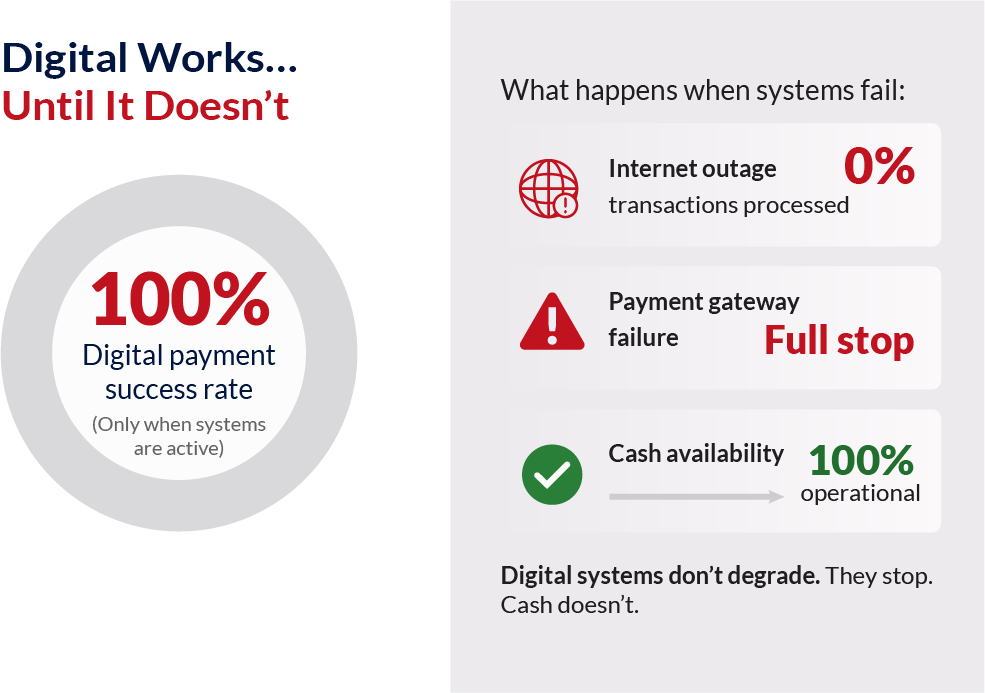
Even in a highly digital market like the U.S., cashless future risks are the reason cash hasn’t disappeared.
Why? Because systems fail, networks go down, and not every situation is fully digitized.
- Some small businesses still accept cash as a fallback
- Customers often want privacy or direct control over their money
- Cash avoids delays and dependencies that digital payment failures can introduce
Cash isn’t just an offline payment method.
It’s a safety net.
Remove it entirely, and you’re removing a layer of trust and reliability that still matters, even in the most advanced markets.
The Delivery and Small-Business Gap
Digital systems dominate at large retailers and platforms. But smaller operations tell a different story:
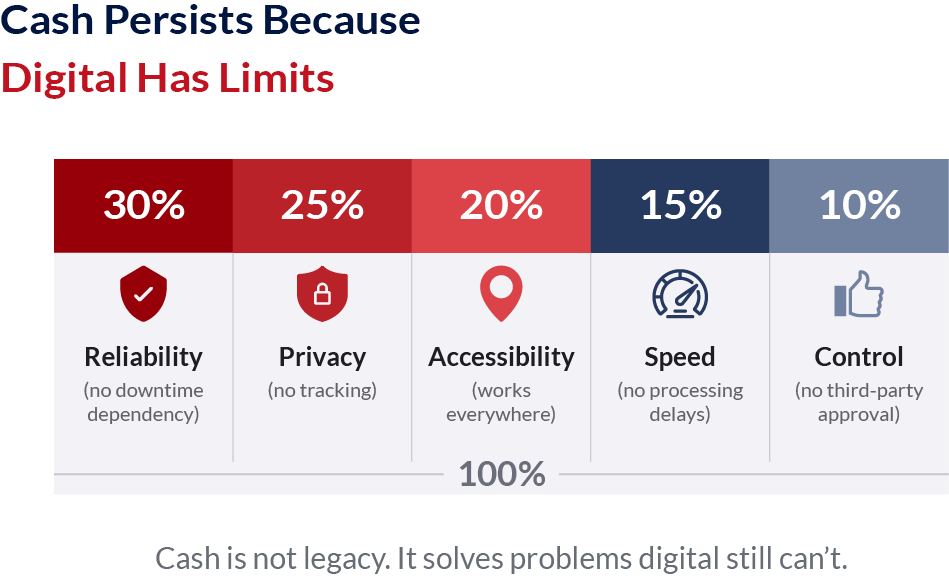
- Food delivery and courier networks can’t realistically equip every driver with card machines
- Independent sellers, farmers’ markets, and local vendors sometimes rely on cash to ensure sales
- Equipment failures, mobile outages, or system downtime can instantly disrupt business
Expecting every transaction to be digital, all the time, isn’t innovation; it’s impractical.
Cash continues to keep commerce moving when digital fails.
Systems Fail, Cash Doesn’t
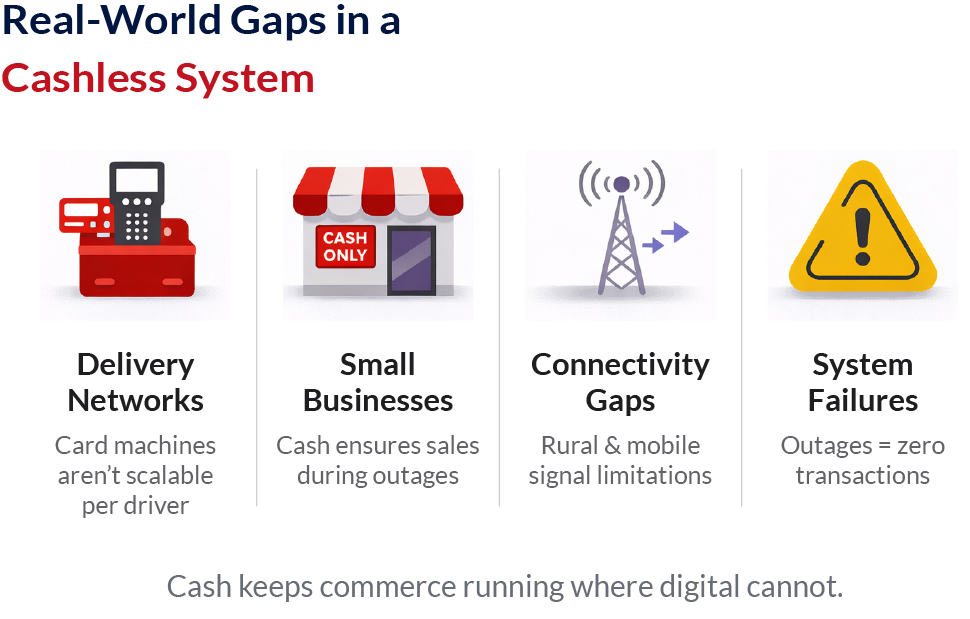
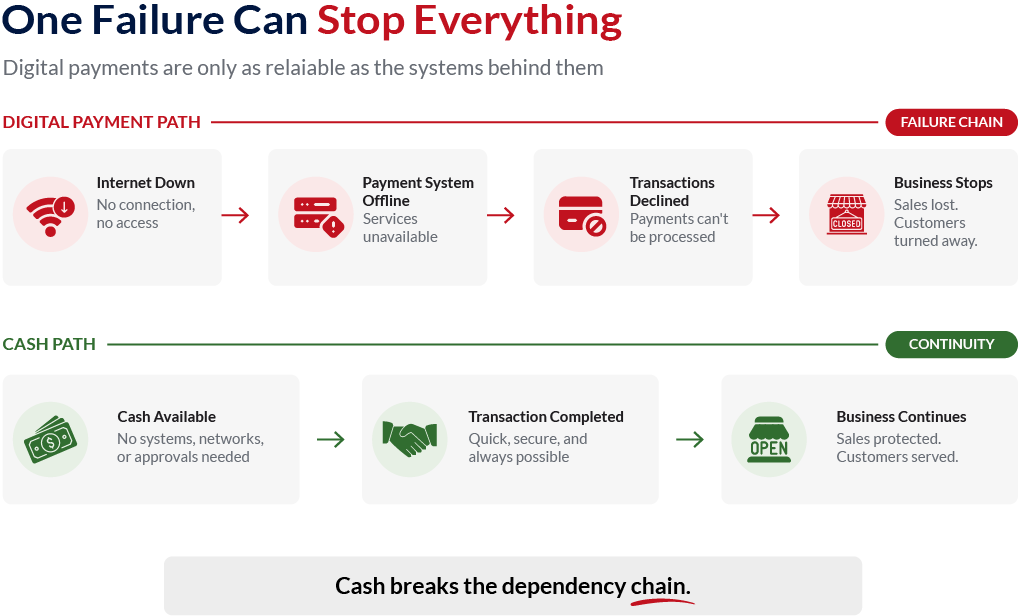
This is where cashless future risks become impossible to ignore, because digital systems don’t fail gradually; they stop completely. Digital payments work well, but only when everything else works:
- Internet outage → no transactions
- Server crash → business disruption
- Payment gateway issue → delays or failures
Digital systems don’t fail gradually—they stop.
Cash doesn’t rely on uptime.
It doesn’t need networks, servers, or approvals.
It just works.
Visibility, Privacy, and Control
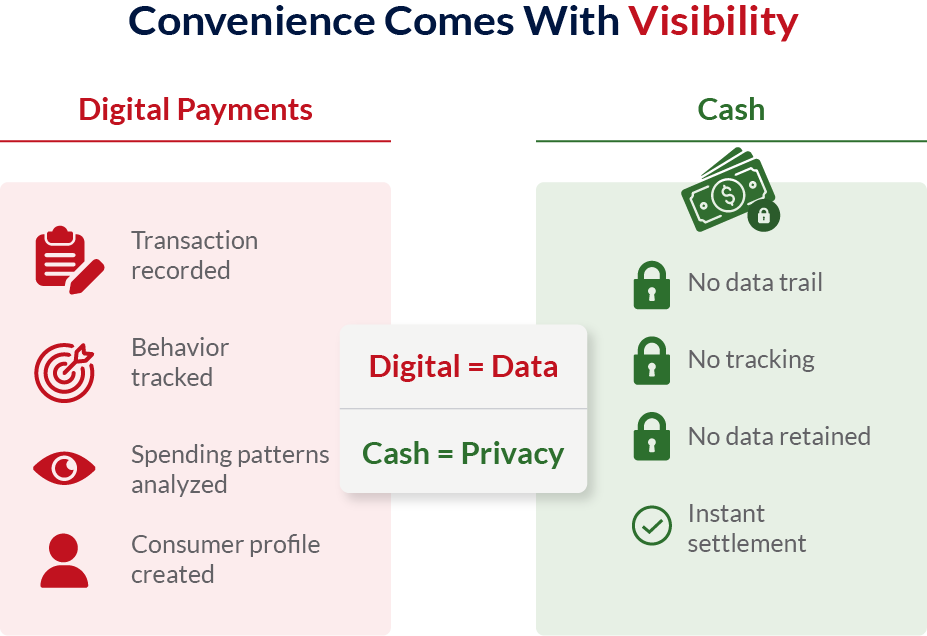
Beyond convenience, a cashless future risks also include loss of privacy and reduced control over personal finances. Every digital transaction creates a data footprint:
- What you bought
- Where you bought it
- How often do you spend
- That data is tracked, analyzed, and used to influence future purchases and even financial access and control.
With cash, a transaction ends when the money changes hands.
No data, no tracking, no system analyzing your behavior. Just payment.
The Bigger Shift: Access vs. Ownership
In a fully digital system, your money is no longer yours; it’s accessed through banks, payment platforms, or networks.
- Transactions can be blocked
- Access can be restricted
- Rules can change overnight
That’s not ownership. That’s permission.
Digital Isn’t the Enemy, Over-Reliance Is
Digital payments are essential. They drive speed, scale, and efficiency.
But removing cash entirely isn’t progress, it’s over-optimization without resilience.
You lose:
- Flexibility
- Backup
- Independence
All for a system that only works when everything else does.
ATM Infrastructure USA: The Safety Net
If cash is the fallback, access to cash must be accessible, reliable, and available.
This is where ATM networks in the U.S. play a critical role, not as an alternative to digital, but as the layer that keeps commerce moving when digital systems fail.
Thousands of businesses rely on cash access every day, not because they reject digital, but because they can’t afford downtime.
The Future Isn’t Cashless, It’s Balanced
The goal was never to eliminate cash.
The goal was to improve how we use money.
A fully cashless U.S. system introduces new risks and removes the only method that works without conditions.
The real future is balanced:
- Digital drives efficiency
- Cash provides resilience
Because when systems fail, and they will, the method that still works isn’t optional. It’s essential.
Final Thought
If your business relies entirely on digital payments, and you don’t have a payment strategy, you have a vulnerability.
Make sure your customers can always pay.
No matter what.